The chapter sounds polished. The sentences flow, the dialogue is grammatical, and the ending lands on a dramatic line. Then you notice the protagonist is angry about a secret she has not learned yet.
That is the kind of problem another round of sentence polishing will miss.
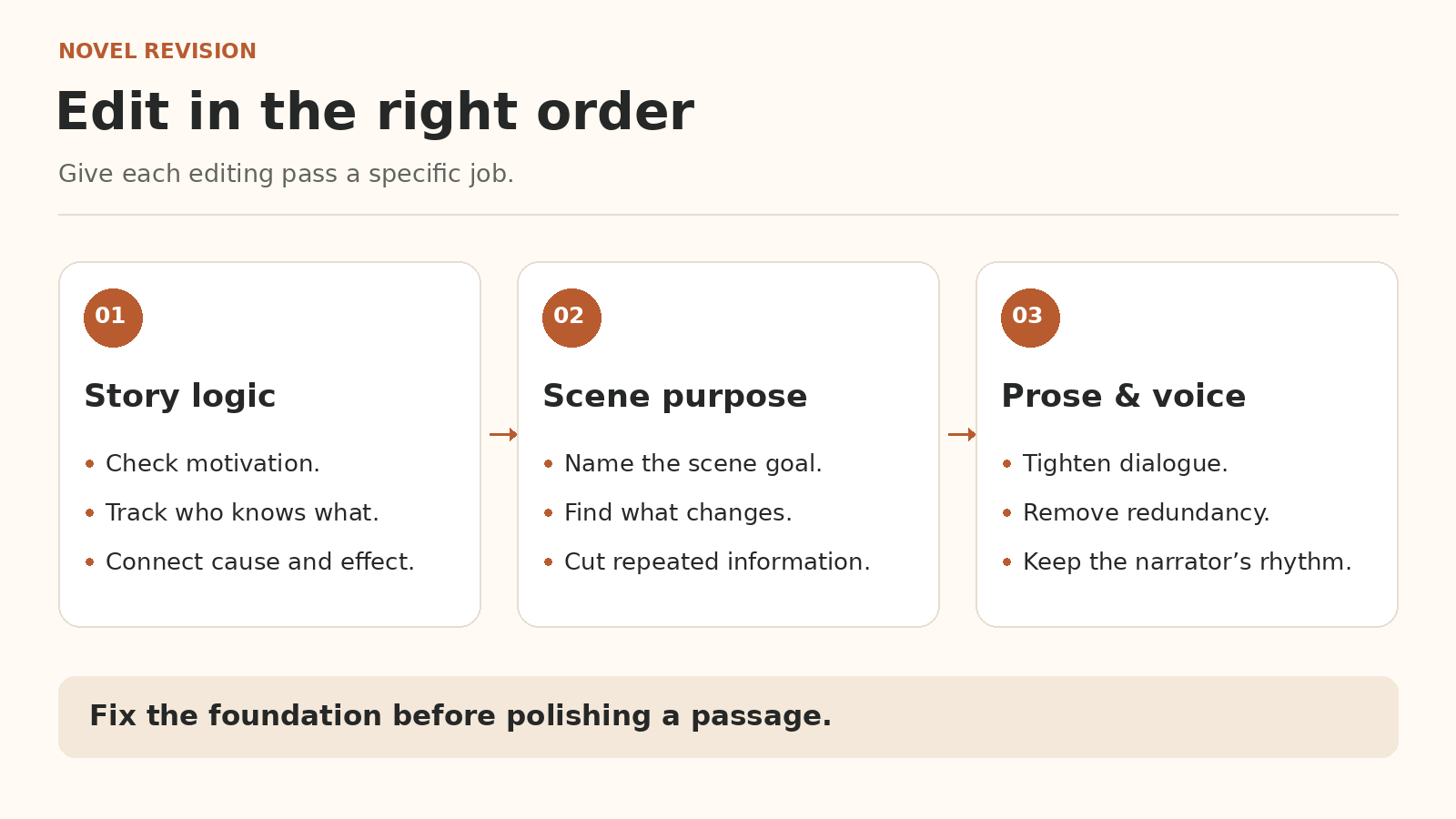
To edit an AI-generated novel, work from story logic to scene structure, then finish with the prose. Give each pass a specific job. In XPT, you can bring a chapter and its context, request focused feedback, and revise the passages you choose.
Here is a practical way to do that without turning every chapter into the same smooth, interchangeable voice.
Decide Which Kind of Edit the Draft Needs
Read one chapter without changing anything. Write down where you lose interest, become confused, or stop believing a character. Sort those observations before asking for help.
| What you notice | Editing pass | A useful question |
|---|---|---|
| Events happen, but the protagonist barely influences them | Structure | Which decision causes the next problem? |
| A character knows something too early | Continuity | Where does the manuscript first establish this knowledge? |
| Two scenes deliver the same information | Pacing | What changes in the second scene? |
| Everyone explains exactly what they feel | Dialogue | What would each person avoid saying aloud? |
| The story works, but paragraphs repeat themselves | Line editing | Which sentences add information or a distinct perspective? |
Start with the problem that affects the most pages. If you may remove a scene, leave its sentence-level polish until later.
How to Edit an AI-Generated Novel With XPT
Step 1: Share One Chapter and the Context It Depends On
Open the AI Novel Editor and paste the scene or chapter you want to examine. Add a compact brief: genre, viewpoint, tense, the character's immediate goal, and a recap of relevant events.
Include facts the chapter must respect. For example: “Nora believes her father is alive. The reader knows he died. Nora discovers the truth in chapter nine.” That distinction helps you ask a much more useful continuity question.
For a longer project, maintain a separate reference document using the AI Story Bible Generator. Bring the relevant notes into each editing request. Update them when you accept a change.
Step 2: Request Feedback Before Requesting a Rewrite
Ask for one editorial pass. Specify the output you need: a short quotation, the problem, its effect, and a possible fix. This makes comments easier to check against the manuscript.
Use the prompt that matches your current concern:
| Pass | Copy-ready prompt |
|---|---|
| Story logic | Review this chapter alongside my story notes. Flag decisions that lack a clear motive and events that depend on an unexplained coincidence. For each concern, quote the relevant line and explain the missing connection. Suggest up to three repairs. |
| Continuity | Compare the chapter with the supplied timeline and character notes. Check location, elapsed time, possessions, and who knows each secret. Separate confirmed contradictions from questions the excerpt cannot answer. |
| Dialogue | Review this exchange for repeated information and voices that sound alike. Identify what each speaker wants and what they are avoiding. Suggest changes to three lines while preserving the scene's outcome. |
| Prose | Mark repeated imagery, redundant explanations, and generic emotional statements. Recommend deletions first. Preserve deliberate fragments, unusual word choices, and the narrator's dry humor. |
Check every flagged issue. A comment about missing motivation may point to information in an earlier chapter. Supply that passage before changing the story to solve a problem that is already addressed.
Step 3: Revise a Small Passage and Check the Consequences
Choose one suggestion and apply it to a limited section. Give XPT the exact passage and the change you have decided to make.
For example: “Revise the argument so Nora avoids naming her suspicion. Keep her final decision to leave, the close-third viewpoint, and the abrupt sentence rhythm. Return the revised exchange followed by a brief explanation of the changes.”
Read the result beside the original. Then read the paragraphs immediately before and after it. A stronger line can still create a new problem if it changes the character's knowledge, confidence, or next action.
What a Useful Revision Looks Like
“Make this more vivid” often produces more description. A better request identifies what the passage needs to accomplish.
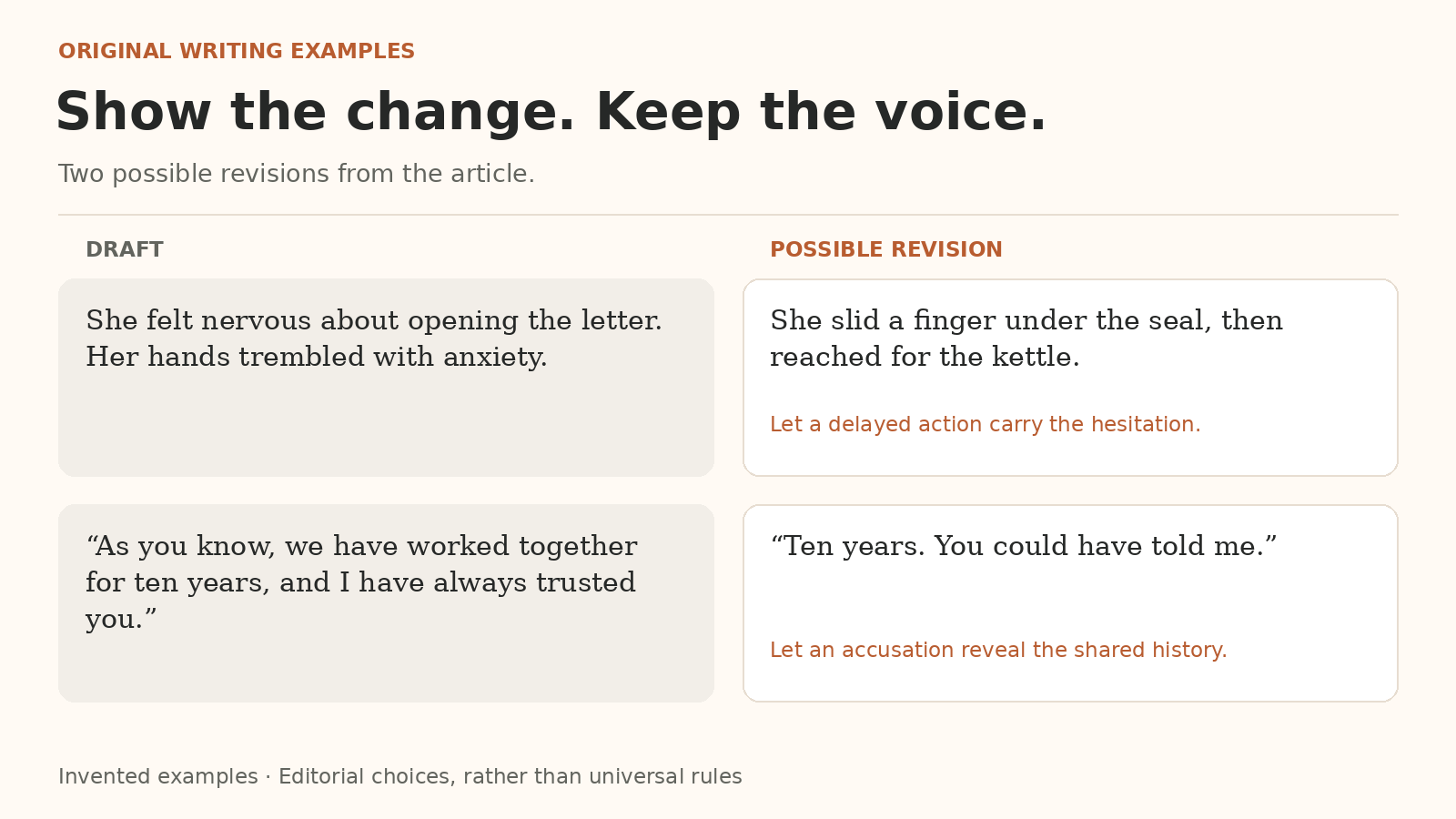
These invented examples show the difference:
| Draft passage | Possible revision | What changed |
|---|---|---|
| She felt nervous about opening the letter. Her hands trembled with anxiety. | She slid a finger under the seal, then reached for the kettle. | A delayed action carries the hesitation; the emotional explanation becomes unnecessary. |
| “As you know, we have worked together for ten years, and I have always trusted you.” | “Ten years. You could have told me.” | The relationship emerges through an accusation instead of a shared-history recap. |
These are choices, not universal improvements. Direct emotional language may suit your narrator. Keep it when it earns its place.
Finish With a Reader Pass
Save the revised manuscript as a separate version. Read it in order without asking for more edits. Note where you need to reread, where a conversation drags, and where a later scene relies on a detail you removed.
Share the coherent draft with human readers when possible. Ask concrete questions: “When did you suspect the brother?” is easier to act on than “Was it good?”
Can I ask AI to edit the entire novel at once?
A chapter list can support an overall structural review. For detailed editing, smaller sections make it easier to supply relevant context, verify comments, and track revisions.
How do I stop every character from sounding the same?
Describe each speaker's intention and habits, then provide a short dialogue sample. Compare sentence length, directness, humor, and what each person leaves unsaid.
Should I rewrite a weak chapter from scratch?
First identify whether the problem is its purpose, its events, or its wording. A chapter with the wrong outcome may need rebuilding; a strong scene with repetitive prose may need cuts.
How do I keep my own writing voice?
Provide a passage you like and name its specific qualities. Review changes aloud. Keep the phrasing that belongs to the narrator, even when a smoother alternative is available.
Bring one chapter to XPT's AI Novel Editor and start with the editing pass it needs most.