To write a novel with AI, open the XPT AI Novel Generator, enter a book brief in the request box, and generate a plan before asking for chapters. Use separate requests for the story reference, chapter outline, scene draft, and revision. Save the decisions you accept and include the relevant ones in each later request.
This walkthrough starts with a new idea and ends with a first chapter you can continue. You will use the same XPT entry point for planning and drafting, while keeping your master manuscript and accepted notes in a document you control.
1. Open the XPT AI Novel Generator
Open the AI Novel Generator and use the request box to describe the book you want to develop. Begin with a planning task rather than asking for a complete manuscript. Include the genre, protagonist, central problem, setting, and the kind of ending you are considering.

2. Enter Your Premise and Generate Planning Options
In the XPT request box, ask for a premise review and three escalation options. Generate the response, choose a direction, and save the version you want to develop. If you already have an ending, include it so the suggestions have a destination.
A setting is not yet a novel premise. “A city where memories are rented” tells you something interesting about the world; it does not tell you whose life becomes difficult because of it. Add a character, an urgent goal, and an obstacle that forces choices.
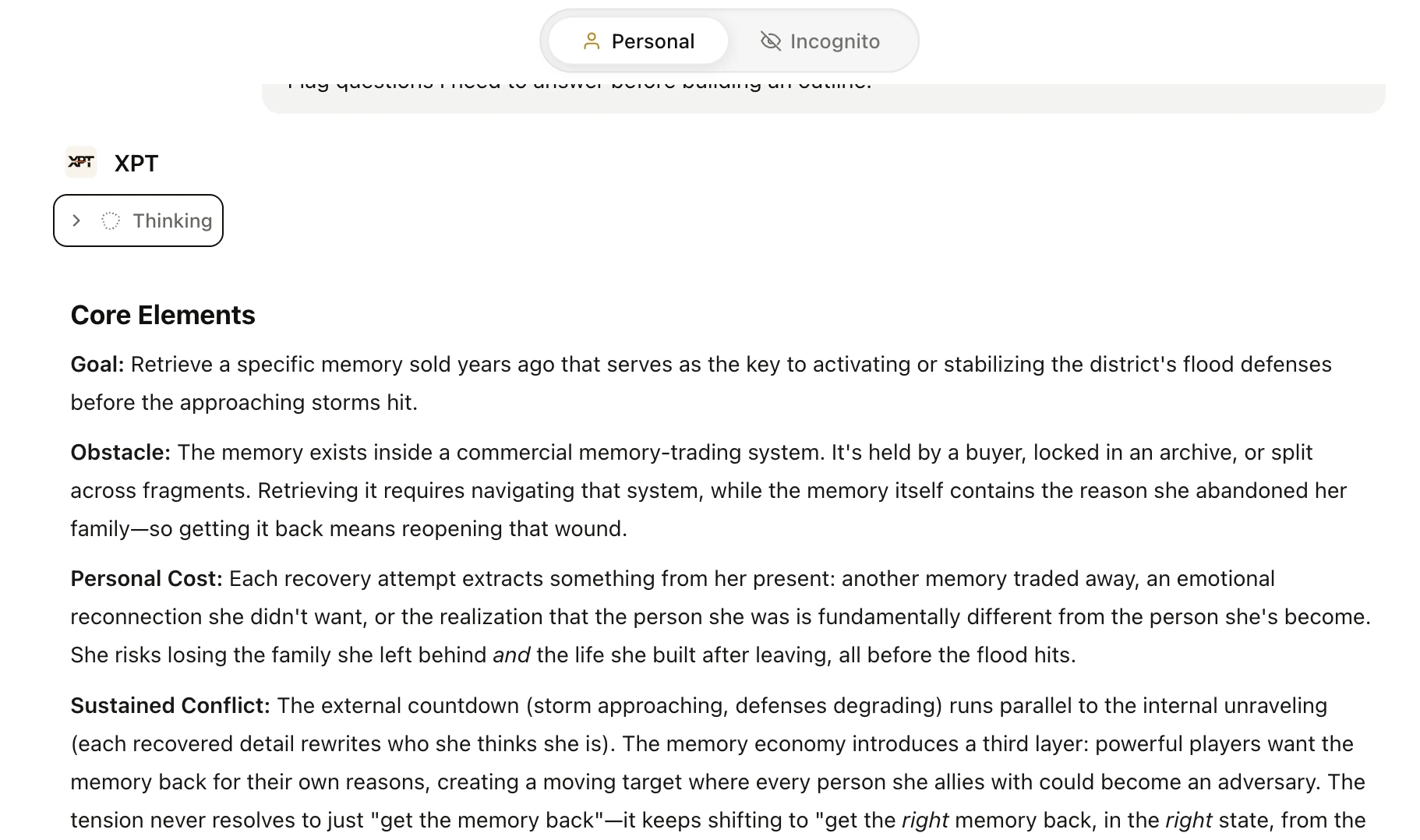
For example: a municipal archivist discovers that the city's flood defenses depend on a memory she sold years ago. Recovering it could save the district, but it would reveal why she left her family. This premise has an external problem and a personal cost. Both can change as the story progresses.
Ask AI to test the premise before expanding it:
"Evaluate this novel premise:
A municipal archivist discovers that the city's flood defenses depend on a memory she sold years ago. Recovering it could save the district, but it would reveal why she left her family. As severe storms approach, she must decide whether to confront her buried past or risk the lives of thousands of residents. Every attempt to recover the memory draws her deeper into a system where personal memories have become valuable commodities, and powerful figures will do anything to keep certain secrets hidden.
Novel constraints:
- Genre: Speculative fiction, mystery, psychological drama
- Target audience: Adult readers
- Setting: A near-future coastal city where human memories can be bought, sold, and stored
- Length: 80,000–100,000 words
- Point of view: Third-person limited
- Tone: Atmospheric, suspenseful, emotionally complex
- Core themes: Memory, identity, family secrets, sacrifice, and personal responsibility
- Content boundaries: Keep the memory-trading technology logically consistent. Avoid convenient solutions, excessive graphic violence, and sudden revelations without proper foreshadowing.
Identify the protagonist's goal, obstacle, personal cost, and likely source of sustained conflict.
Give me three different ways to escalate the problem through the protagonist's own choices. Make sure each escalation increases both the external danger and the personal stakes.
Do not write chapters or choose an ending yet.
Flag questions I need to answer before building an outline."
Keep the direction that interests you, even if it is not the neatest option. A useful checkpoint is whether you can describe what the protagonist wants and why getting it could hurt.
3. Ask XPT to Organize Your Accepted Story Facts
Replace the planning request with your chosen premise and notes, then ask XPT for sections covering characters, relationships, world rules, and unresolved questions. Tell it to place new suggestions in a separate section. Save the entries you approve outside XPT before moving on.
Record enough to prevent basic contradictions: main characters, relationships, setting rules, important past events, point of view, and tense. Separate accepted facts from possible ideas. An unapproved suggestion should not enter the next scene as established history.
Keep the approved reference in your own document. Include the relevant entries in later XPT requests and check proposed additions before they become canon.
A practical character entry needs more than personality adjectives. For the archivist, record her immediate goal, what she conceals, the person she avoids, and the line she believes she will never cross. Leave undecided biography blank until the plot needs it.
4. Generate a Chapter Plan from Those Facts
Paste the accepted reference into a new XPT request and ask for a chapter plan. Request the POV, goal, obstacle, consequential choice, and ending state for each chapter. Review the plan before submitting a scene-writing prompt; a list of events alone is not enough to guide the draft.
A chapter plan that says “visit the archive, meet the mayor, find a clue” may produce scenes where information arrives but nothing changes. For each chapter, decide what the viewpoint character wants, what prevents it, and what their response makes possible or impossible next.
| Chapter question | Example answer |
|---|---|
| What is the immediate objective? | Retrieve the flood-system maintenance record. |
| What blocks it? | The record is locked to a memory she no longer owns. |
| What choice does she make? | She uses a relative's credentials without permission. |
| What changes? | She gets access but leaves a trace that implicates the relative. |
| What carries forward? | She must repair the betrayal while the deadline closes in. |
Ask for several possible turning points and choose among them. Once you have a direction, review the outline backward from the ending: does each major decision help make that ending possible, or is the book depending on a convenient discovery?
5. Paste a Scene Brief and Generate the Opening
Select the first scene from your plan and submit the brief below to XPT. Ask for one bounded scene, not the entire book. The result should reach the specified stopping point without solving a later conflict.
Before drafting, create a scene brief. Include the viewpoint character, location, current knowledge, immediate goal, obstacle, intended change, and a stopping point. Give voice instructions through observable choices, such as short sentences under stress or attention to bureaucratic details, rather than “make it beautiful.”
Draft the archive-access scene in close third person, past tense.
The archivist knows [facts] but does not know [secret].
Her goal is to retrieve the maintenance record before closing time.
She must choose whether to use her relative's credentials.
Show the choice through actions and dialogue. Keep exposition brief.
End when she realizes the access log has recorded the borrowed identity.
Do not reveal the contents of the record yet.
Relevant canon: [paste accepted details].
Read the result as a draft. Keep a line because it serves the scene, not because it sounds polished in isolation. If the character's choice is missing, repair that before asking for more descriptive language.
6. Generate a Short Continuity Note
After revising the scene, paste the accepted text into XPT and request only newly established facts, changes in knowledge, and open threads. Check that summary against your manuscript, then add the accepted entries to your own reference.
After accepting a scene, record what changed: who learned something, which object moved, what promise was made, and what relationship shifted. A short update is easier to reuse than a full chapter summary with every atmospheric detail.
For the archive scene, the update might be: the archivist used her relative's credentials; the access is logged; the record has been retrieved but not read; the relative does not yet know. This prevents the next scene from treating the relative as an informed accomplice or revealing information nobody has seen.
When you reject a generated detail, remove it from the working reference. Otherwise, later prompts may revive an idea you thought you had discarded.
7. Use a Focused XPT Request to Revise the Draft
Paste the passage you want to change and specify which parts must stay. Ask for structural repair before sentence polish, then save the revised version you choose. If you use a new request, include the relevant context again rather than depending on earlier material being retained.
Begin with structure. Identify chapters that repeat the same conflict, subplots that disappear, and decisions whose consequences are too easy. Ask for findings tied to chapter labels or supplied passages, then review them yourself.
Next, check continuity and character behavior. Does someone act on information they have not received? Does an ability become stronger only when the plot needs it? Finally, revise prose for dialogue, rhythm, repetition, and viewpoint. Sentence polishing cannot repair a missing cause-and-effect chain.
Preserve passages you want to keep before requesting rewrites. A targeted instruction—“cut the explanation after the refusal and keep the physical action”—gives you more control than “improve this chapter.”
When Your XPT Draft Does Not Follow the Plan
Use the same request box for a correction, with the problem stated first: “Revise this passage because [specific issue]. Preserve [facts]. Change only [scope].” Include the passage itself so the correction has a clear target.
If each chapter sounds like an opening, provide the current story state and explicitly forbid a restart or recap. If the cast becomes interchangeable, revise dialogue around competing goals. If the plot expands endlessly, return to the central problem and identify what the next scene must resolve or complicate.
If you are spending all your time planning, choose one scene and write it yourself. The purpose of the workflow is a manuscript, and useful planning should make the next page easier to begin.
Before You Continue to Chapter Two
Use one last XPT request to propose a next-scene brief from the accepted chapter and continuity note. Review that brief before generating more prose. This checkpoint keeps the next request tied to the story you actually kept.
A complete first draft is a milestone, not a publication guarantee. Read the full manuscript, verify factual material, review the policies of your intended publisher or platform, and consider feedback from a reader or editor. This tutorial offers a writing method, not evidence from a tested full-novel generation run.
Before you accept your first chapter, check four concrete details: the main character makes a consequential choice; the next chapter begins from its result; nobody uses information they have not received; and the story bible contains only the version you chose. If one check fails, revise that part before expanding the manuscript.
Start by testing one premise and drafting one scene. Once that scene holds together, use the same brief–draft–review–update cycle to build the rest of the book.
A Revision Request to Use in XPT
Paste the passage you want to change after these instructions, generate a revised version, and compare it with the draft you saved. Replace the bracketed details with facts from your own project. Start Planning Your Novel with XPT Now!
Preserve the character goal and accepted world rules. Revise the scene so the protagonist makes a consequential choice, and end at its immediate cost. Do not add a new solution or summarize the next chapter.
Passage to revise: [paste the accepted draft here].
Relevant facts to preserve: [paste the brief here].