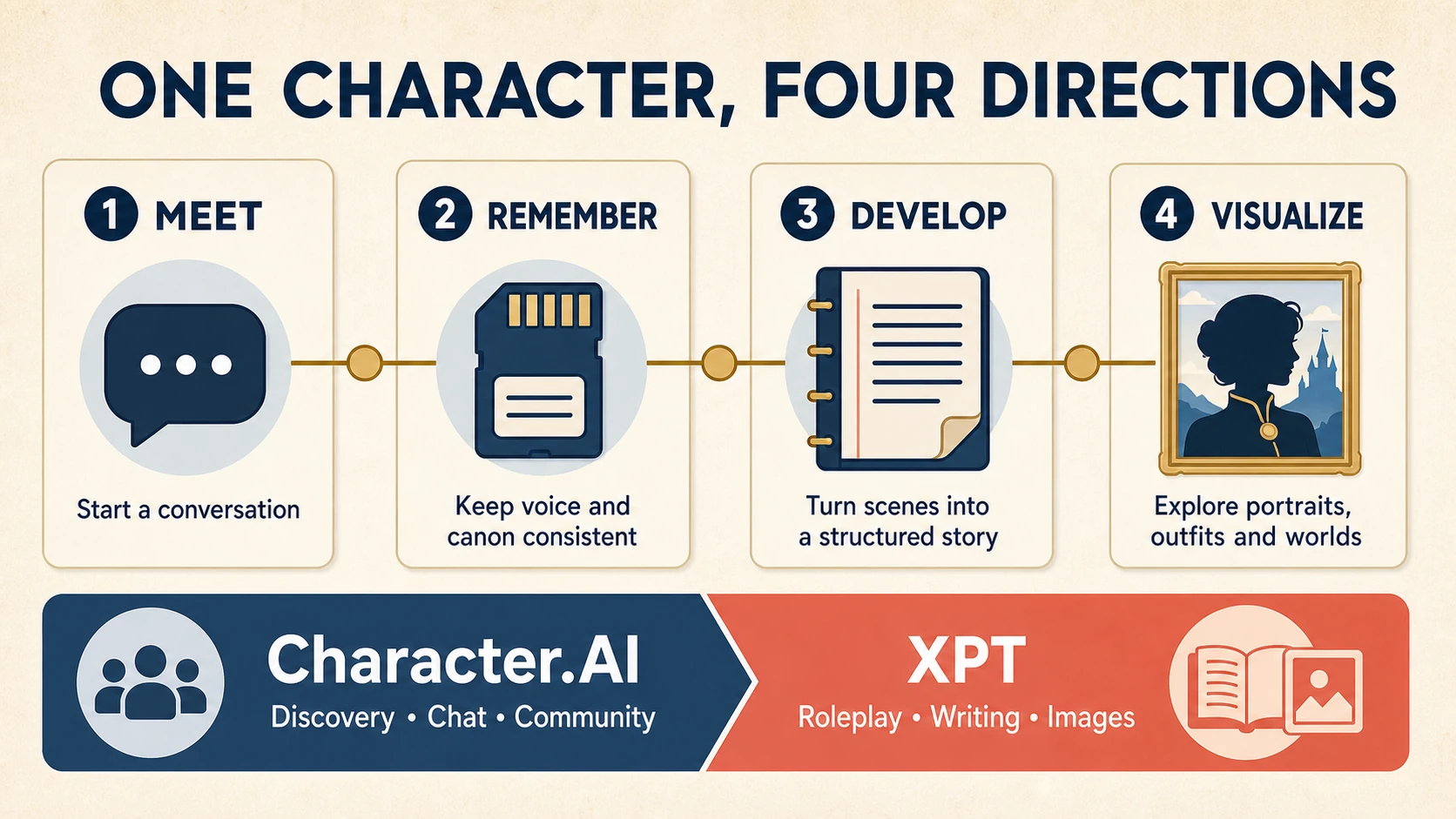
Character AI is built around meeting, creating and sharing personalities. XPT is built around taking an idea further—through roleplay, structured character development, story writing and images.
Choose Character AI when the main experience is talking with a character. Choose XPT when the character needs to become part of a larger creative project that you continue to shape.
That does not make Character AI a basic chatbot. It now combines a large character community with voices, calls, Scenes, a social Feed, branching Stories, visual experiments and creator tools. The useful distinction is not which platform has more features. It is who controls the direction once the first conversation becomes a world, a plot or a visual concept.
Start With One Character, Not a Feature List
Use the same creative brief on both platforms:
Create Mara, an archivist who protects a city’s forbidden map collection. She is observant, slow to trust and hiding one decision that could change the city. Begin with a tense first meeting, then develop her into a short story, an evolving world and three visual directions.
This brief reveals four different versions of the same character:
- A personality you can meet.
- A character who must remain consistent.
- A protagonist who has to carry a plot.
- A visual identity that must match the writing.
Character AI and XPT feel closest during the first step. After that, their priorities begin to separate.
Version One: A Character You Can Meet
This is Character AI’s home ground.
You can search a large public catalog, follow creators or build a private, unlisted or public Character of your own. A Character profile can include a name, avatar, tagline, description, greeting, voice and a detailed Definition. The current creator guide allows up to 32,000 characters in that Definition, including dialogue examples that demonstrate how the Character should speak and react.
The interaction is designed to feel immediate. You choose someone, enter the chat and respond from inside the scene. Voice calls, alternative replies, chat branches and different chat styles make it easy to treat the conversation as entertainment rather than a writing assignment. Character AI also gives creators a built-in audience through search, profiles, leaderboards and its Feed.
XPT does not try to replace that public character network. Its Free AI Roleplay Chat starts from your own character, setting and opening conflict. This is more useful when you already know the kind of scene you want and would rather shape it directly than browse a catalog.
Character AI has the advantage in discovery and community. XPT gives the creator a more direct starting point.
Version Two: A Character Who Must Remember
A convincing opening is easy to notice. Consistency after dozens of exchanges is harder.
Character AI gives creators several ways to anchor behavior. Definitions establish identity and voice. Pinned details and Auto Memories help individual chats retain important information. Its current Lorebooks feature lets a creator define places, side characters, factions, objects and world rules that activate when relevant keywords appear. Lorebooks remain in beta, and creating or editing them currently requires c.ai+.
The design is particularly useful when one creator wants several public Characters to share the same canon. It is less flexible when you are chatting with somebody else’s public Character and want your private version of the story to evolve away from the creator’s original world. Users cannot attach their own Lorebook to a Character they do not own.
User discussions also show why memory remains a deciding factor. People describe Characters forgetting recent facts, returning to a default personality, repeating familiar phrases or requiring several swipes before a reply fits the established voice. Other users report that paid models, Auto Memories and Lorebooks improve long sessions. The experience depends on the Character setup, model, chat style and length of the story.
XPT approaches consistency less like a social character profile and more like an editable creative brief. The AI Character Description Generator can help turn scattered notes into a clear reference covering motives, contradictions, voice, relationships and visual details. You can then bring that reference back into roleplay or use it as the basis for a story.
XPT should not be treated as perfect memory. Long projects still benefit from a short canon sheet and occasional reminders. Its advantage is that you can revise the source material yourself instead of depending entirely on the behavior of a published Character.
Version Three: A Character Who Must Carry a Plot
Character AI is strongest when the story develops through conversation. Rewind and chat branching let you revisit a moment and try another response. Scenes offer prepared situations, while Stories turn Characters into branching, narrated experiences. These formats are good for improvisation, surprising dialogue and stories that are meant to be played rather than finished.
The challenge appears when you want to step outside the chat and become the author again. A lively roleplay transcript is not automatically a coherent short story. It may contain repeated beats, unresolved branches, shifting points of view and dialogue that worked interactively but needs editing on the page.
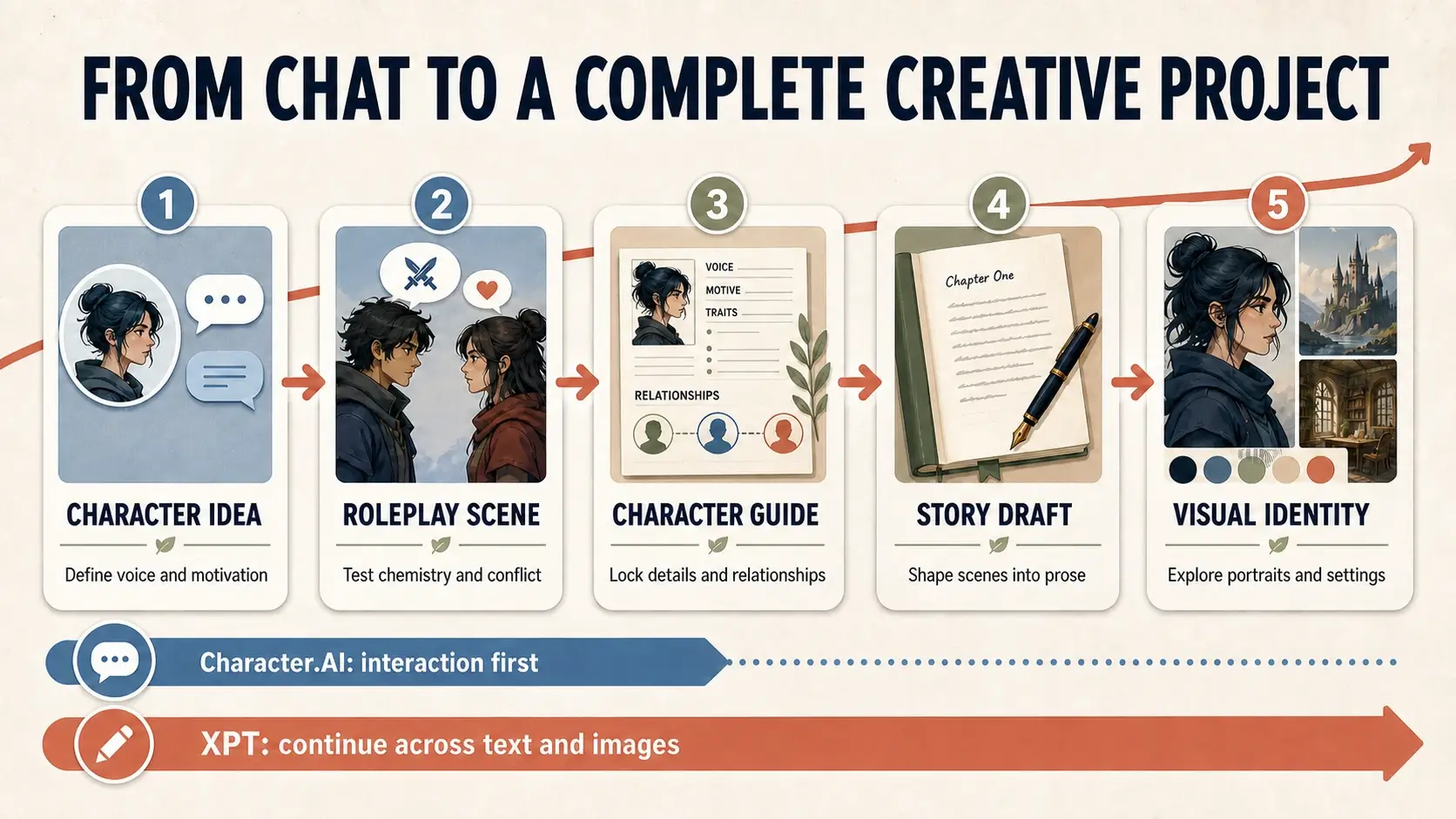
XPT is better suited to that handoff. You can roleplay the difficult scene first, identify the strongest exchange, then ask for a chapter outline, rewrite the scene from another point of view or turn the conversation into polished prose. The same workspace can move between character dialogue, narration, plot structure and revision without forcing the project to remain a chat simulation.
This is also where XPT’s less-restricted creative positioning matters. It is designed to reduce unnecessary interruptions in legitimate creative work, while Character AI applies a more tightly moderated entertainment framework. XPT still operates within law, product rules and model limits; “more room to create” should not be read as a promise that every request will be completed.
Version Four: A Character Who Needs a Visual Identity
Character AI is no longer text-only. Its Feed and Labs experiments include generated backgrounds, Streams, Stories and AvatarFX video. These tools are designed to make Characters more shareable and interactive inside the Character AI entertainment ecosystem. Because Labs is explicitly experimental, individual formats may change, move or disappear as the company tests them.
XPT’s visual workflow is more direct. After defining Mara’s history, mannerisms, clothing and emotional state, you can continue with the AI Character Image Generator to test portraits, outfits, expressions and environments. The image is treated as part of character development rather than primarily as a social post or entertainment format.
The difference is practical:
- Character AI asks how a Character can become more interactive and discoverable.
- XPT asks how the creator can turn the same Character into consistent text and visual material.
Choose the first when the audience should meet the Character. Choose the second when you are still deciding who the Character becomes.
Before You Choose, Check Three Boundaries
What kind of experience does each platform prioritize?
Character AI is designed around interactive entertainment: users discover, create and chat with personalities, then extend those interactions through voice, Scenes, Stories, Feed and creator features. XPT is a more general AI workspace. Roleplay is one use case alongside writing, research, idea development and image creation, so a character can remain part of a wider project instead of defining the entire product experience.
What does the subscription actually improve?
Character AI can be used without c.ai+. Its current Plus subscription is $9.99 per month or $94.99 per year and adds benefits such as better memory, ad-free chats, access to newer models, no slow mode, unlimited voice calls and more swipes. XPT also has a free entry point; its paid plans begin with Pro at $12.90 per month, followed by Max at $29.90 and Ultra at $79.90.
These are not matching plans. c.ai+ improves the experience inside a character entertainment platform. XPT’s plans are easier to justify when your work regularly moves among roleplay, writing, model choice and images.
What happens to private creative work?
Character creators cannot see conversations users have with their Characters. Character AI itself still processes account and interaction data, and its documentation explains that user interaction data can contribute to model development. It also documents model-improvement controls and regional opt-out rights; check the setting available for your account before sharing unpublished material.
XPT’s current privacy policy distinguishes Personal mode, which saves encrypted conversation history, from Incognito mode, which XPT says does not store the conversation in its database, on disk or in backups. If you select a third-party model, that provider’s processing terms still matter. Avoid uploading confidential material to either platform unless you understand the full data path.
The Choice Comes Down to Ownership of the Journey
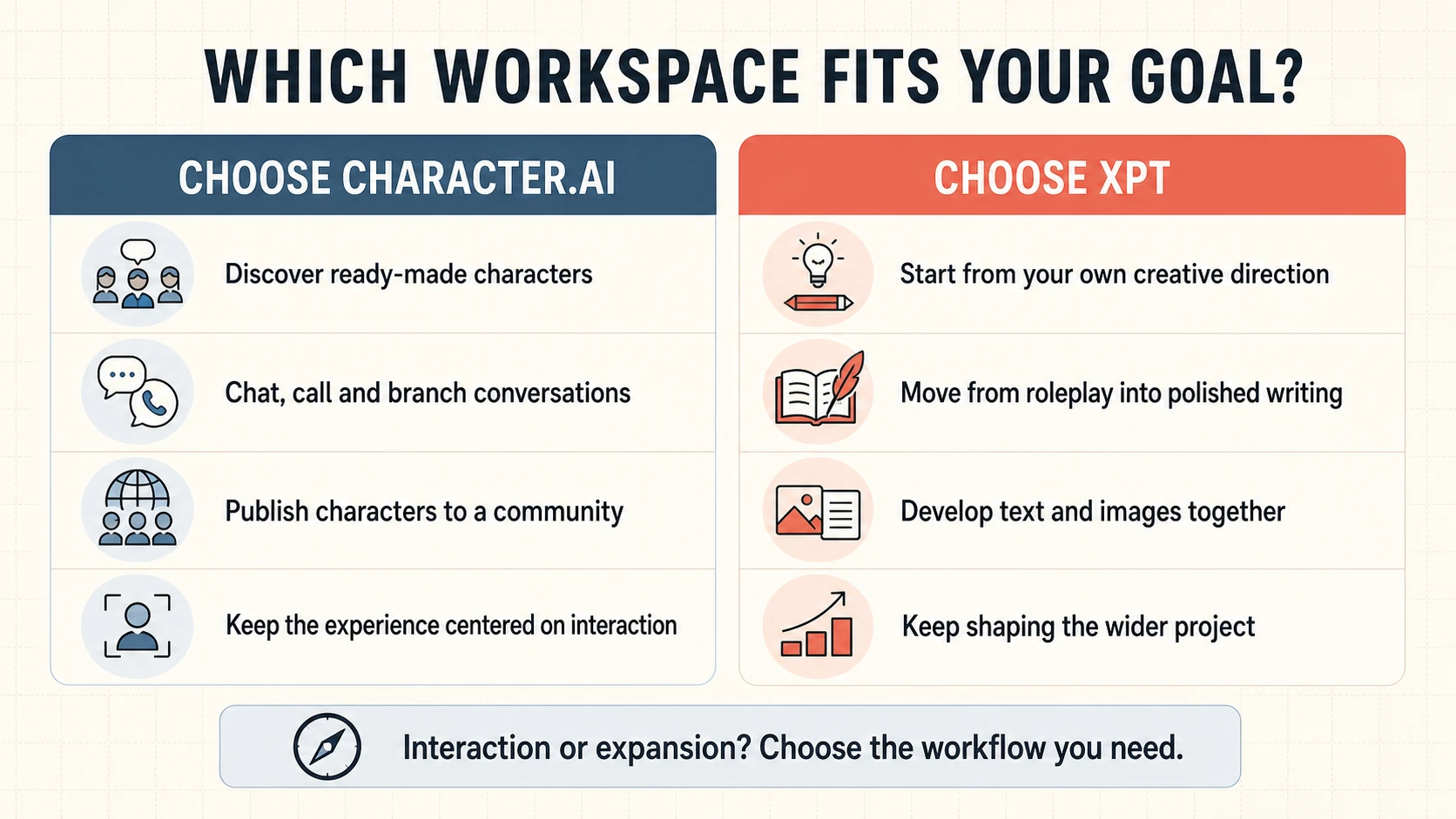
Choose Character AI if you want to:
- Browse a large community of ready-made Characters.
- Chat, call, branch conversations and try different interaction styles.
- Publish Characters and build an audience around them.
- Experiment with social, voice and entertainment formats.
- Keep the final experience centered on meeting the Character.
Choose XPT if you want to:
- Start with your own character and creative direction.
- Move from roleplay into a story, chapter or other finished prose.
- Keep revising the character sheet, voice and plot as the project changes.
- Develop written and visual versions of the same idea.
- Give legitimate creative work more room to continue.
Character AI is the stronger destination for discovering and interacting with AI personalities. XPT is the stronger workspace when a Character is only one part of something larger you are building.
The simplest distinction is this: Character AI helps you enter a Character’s conversation. XPT helps you decide what happens to the Character after that conversation begins.