XPT and DeepSeek can both help with writing and idea development, but they are built around different priorities.
Choose XPT if you want a focused space for freer text and image creation. Choose DeepSeek if you need strong reasoning, long-context work or a low-cost API for your own tools.
The useful question is not which AI is more powerful overall. It is which one gives you the right output with fewer extra steps.
The Quickest Way to Decide
| Your main task | Better fit | Why |
|---|---|---|
| Develop stories, characters or original concepts | XPT | The workflow is designed for open-ended creative exploration and revision. |
| Move from writing to image generation | XPT | Text and visual creation stay in the same creative environment. |
| Work through math, logic or technical analysis | DeepSeek | V4 offers dedicated thinking modes and strong reasoning tools. |
| Process very large amounts of text through an API | DeepSeek | V4 Flash and V4 Pro support a 1M-token API context window. |
| Build with an open model ecosystem | DeepSeek | Model weights and developer integrations support more technical control. |
| Pay a predictable monthly creative subscription | XPT | XPT offers fixed monthly plans instead of token-based API billing. |
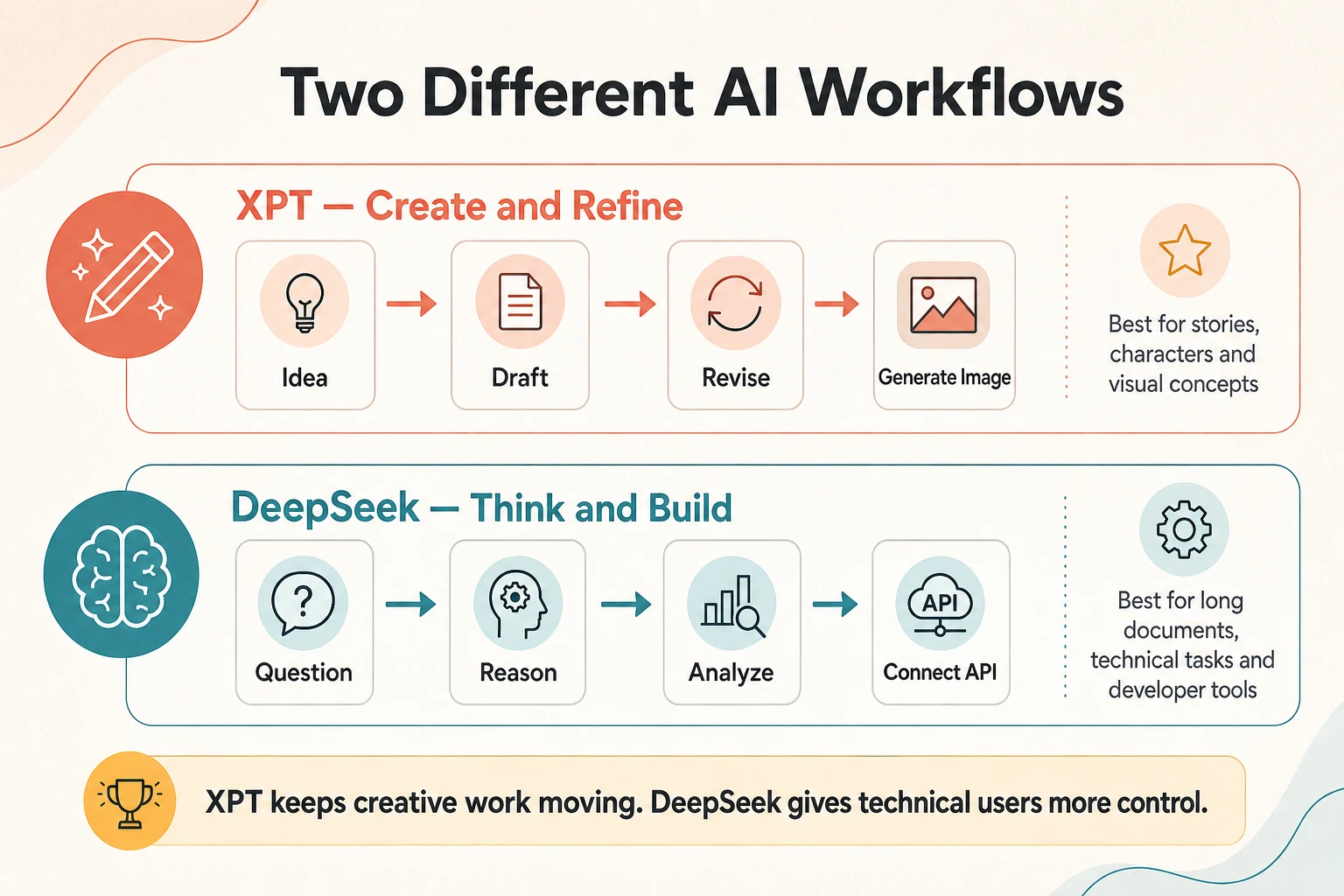
XPT keeps creative work moving from idea to image, while DeepSeek gives technical users more control over reasoning and API workflows.*
Compare the Output, Not Just the Model
When you want to turn an idea into finished creative work
DeepSeek can brainstorm, outline, rewrite and produce long text. Its reasoning mode can also help solve plot gaps or organize a complex brief. However, its main product identity is still centered on reasoning, efficiency and developer use.
XPT is more focused on the creative loop. You can explore several directions, revise the voice and keep developing the same idea without pushing every request into a technical workflow. The Unfiltered AI Writer is useful when you want to move from a rough premise to an editable draft while keeping more control over tone and direction.
This difference matters most when the first answer is only a starting point. Creative work often needs several rounds of changes: make the character less predictable, shift the point of view, increase the emotional contrast or test a completely different ending. XPT is designed for that continued exploration.
When the final output needs to include images
This is the clearest practical difference between XPT and DeepSeek.
DeepSeek can help write detailed image prompts, organize a visual brief or improve a concept before it is sent to another generator. Its main chat and API models, however, are centered on text and reasoning. Creating the final image usually requires a separate image tool and another round of prompt transfer.
XPT keeps that step closer to the writing process. After developing the concept, you can use the Uncensored AI Image Generator to test characters, environments and visual styles without rebuilding the idea in a separate workspace.
For creators who regularly move between prose and images, fewer handoffs can be more valuable than a larger context window.
When the task is analysis rather than creation
DeepSeek has the stronger case here. DeepSeek V4 Flash and V4 Pro support thinking and non-thinking modes, tool calls and a 1M-token API context window. Flash is designed for speed and cost efficiency, while Pro is aimed at more difficult reasoning and agent tasks.
That makes DeepSeek useful for technical documents, structured analysis, large inputs and developer workflows. It can also be connected through OpenAI- and Anthropic-compatible API formats, which makes it easier to add to existing tools.
XPT can support research and open-ended discussion, but its main advantage is not maximum technical depth. It is giving creators a simpler route from idea to text and image.
Where DeepSeek Users Feel Friction
According to Reddit user discussions, DeepSeek's value is widely appreciated, but the experience can vary by model and mode. Users mention several recurring issues:
- Flash is fast and inexpensive, but may need tighter instructions for creative writing or complex tasks.
- Pro can produce deeper answers, but some users find its reasoning longer than necessary.
- Writing quality and instruction-following may feel inconsistent between sessions.
- Choosing between web chat, API access, Flash, Pro and thinking modes adds more setup than a focused creative tool.
These points do not affect every request. They show that DeepSeek often works best when the user is willing to choose the right model, manage prompts carefully and understand token-based usage.
XPT reduces that decision load for creative work. The goal is not to expose more infrastructure; it is to help the user keep creating.
Privacy and Data Controls
DeepSeek allows users to turn off “Improve the model for everyone” and manage or delete chat history through account settings. Its privacy policy also says that user prompts, uploaded files, photos and chat history may be collected, and that personal data may be processed and stored in the People's Republic of China. Users should avoid uploading confidential material unless the service's policy fits their requirements.
For either platform, privacy should be judged by the mode you actually use. Consumer chat, private modes, API access and self-hosted open weights do not have the same data flow. If a project contains sensitive information, check the current settings and policy before uploading it.
XPT vs DeepSeek Pricing
XPT uses monthly subscriptions:
| XPT plan | Monthly price |
|---|---|
| XPT Pro | $12.90 |
| XPT Max | $29.90 |
| XPT Ultra | $79.90 |
DeepSeek's official web chat offers free access, while API use is charged by tokens:
| DeepSeek API model | Cache-hit input | Cache-miss input | Output |
|---|---|---|---|
| DeepSeek V4 Flash | $0.0028 / 1M tokens | $0.14 / 1M tokens | $0.28 / 1M tokens |
| DeepSeek V4 Pro | $0.003625 / 1M tokens | $0.435 / 1M tokens | $0.87 / 1M tokens |
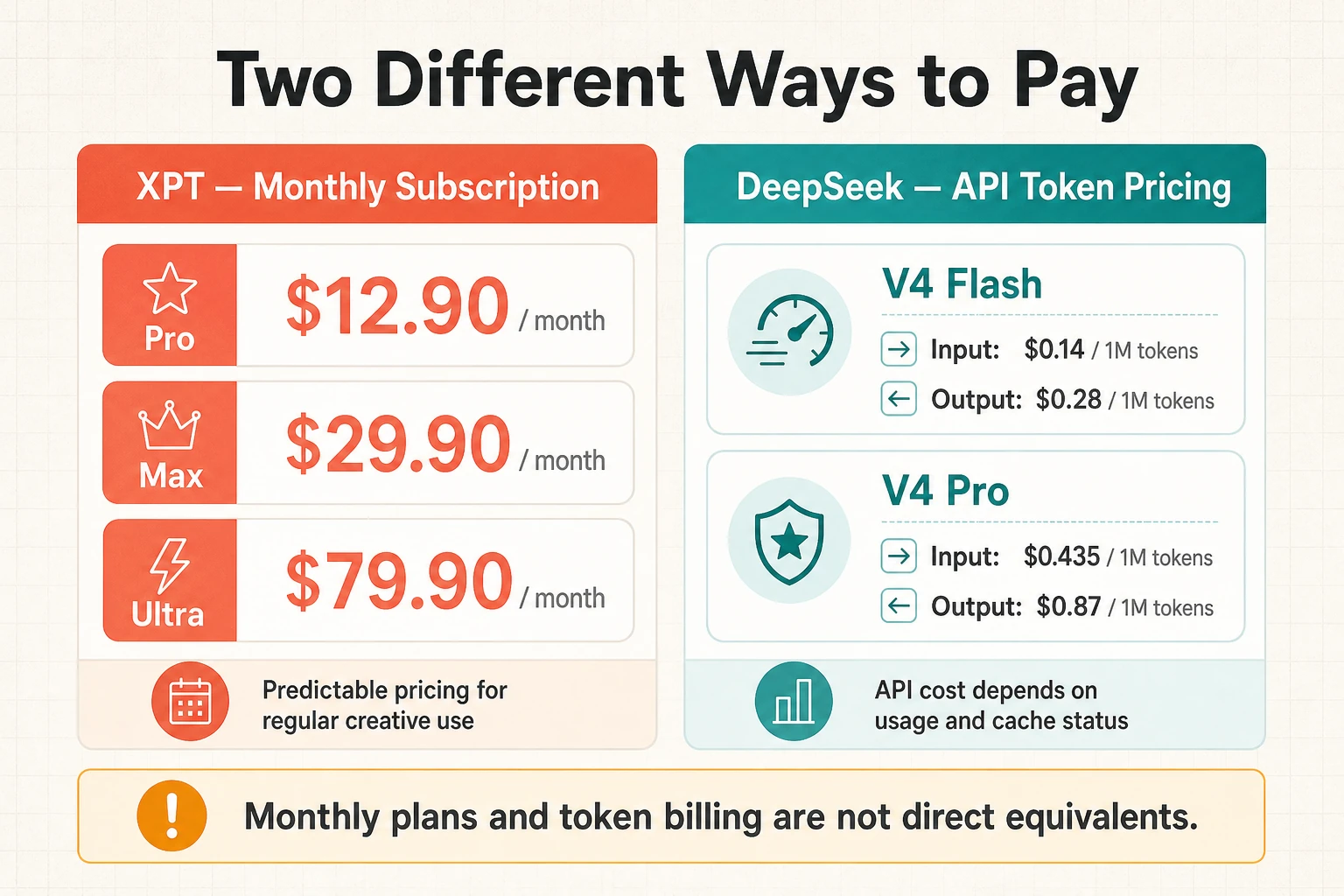
These prices are not direct equivalents. XPT pricing is easier to understand for regular creative use. DeepSeek API pricing can be extremely low for developers, but the total depends on input size, output length, cache use and how often the model is called.
XPT or DeepSeek: Which One Fits You?
Choose XPT if:
- You want freer text and image creation in one place.
- You often revise stories, characters, scenes or visual concepts.
- You prefer a creative interface over model and API configuration.
- You want a predictable monthly plan.
Choose DeepSeek if:
- Reasoning, long documents or technical analysis are central to your work.
- You need a low-cost API for an app, agent or internal tool.
- You want access to open model weights and developer integrations.
- You are comfortable choosing between Flash, Pro and different reasoning modes.
If real-time X posts, video and voice matter more than an open model API, XPT vs Grok covers that decision in more detail.
Final Verdict
DeepSeek offers impressive reasoning and API economics. It is the stronger option for developers, technical users and anyone who needs to process large amounts of text at a low token cost.
XPT is the clearer choice for creative work that moves between writing and images. It removes more of the setup between an idea and the next version, making it easier to keep exploring, revising and creating.