XPT and Grok both offer a more open approach to AI, but they are built for different kinds of work.
Choose XPT if you want a lower-cost creative workspace built around sustained text and image exploration. Choose Grok if real-time X context, web research, voice, video and connected tools matter more than having the simplest creative loop.
The best choice depends on whether you need a focused creative space or a wider assistant connected to live information.
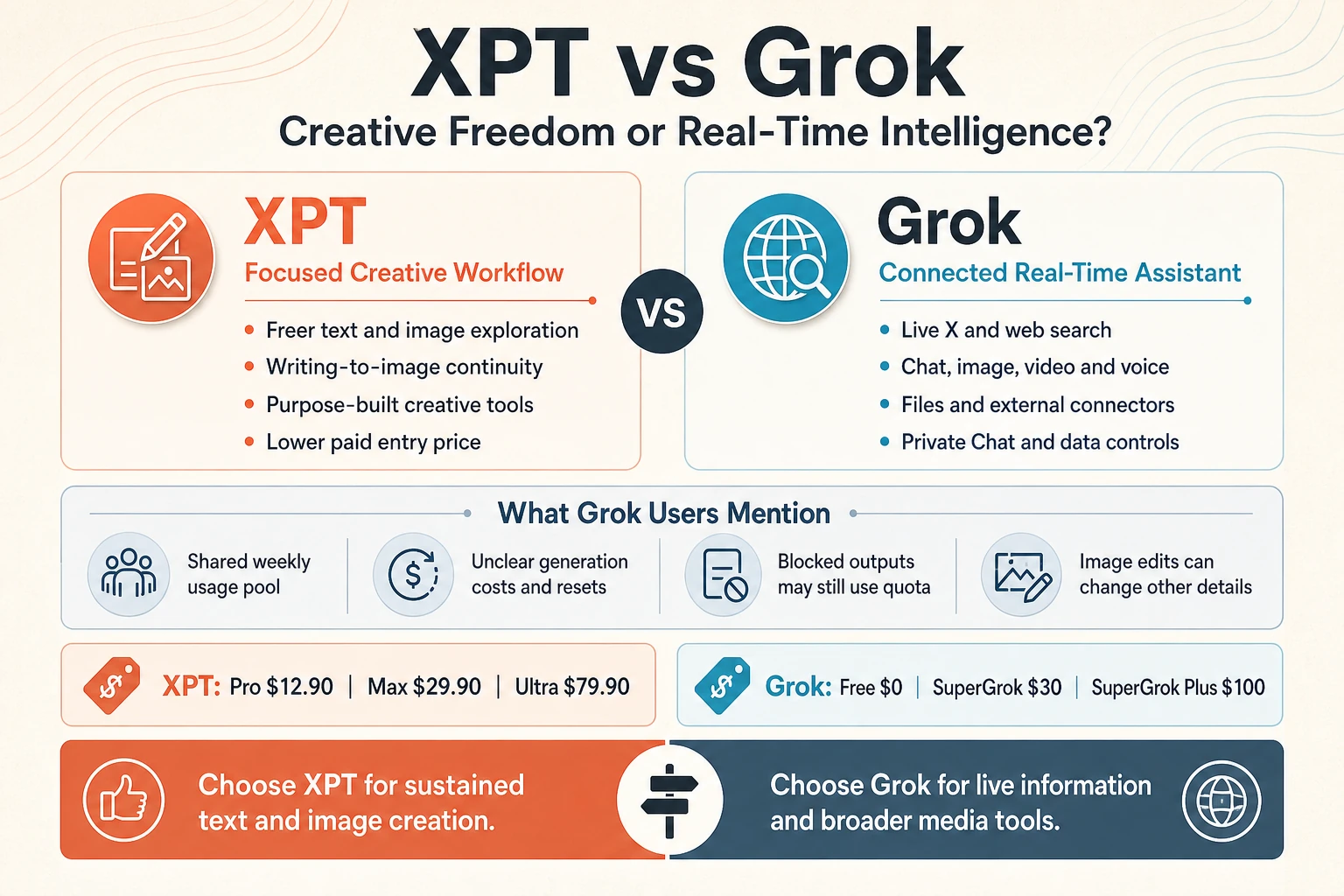
XPT vs Grok at a Glance
| What matters most | Better fit | Why |
|---|---|---|
| Freer text and image exploration | XPT | Its core experience is designed around open-ended creative work and purpose-built creative agents. |
| Live X and web context | Grok | Grok can search public X posts and the web for current information. |
| Video and voice in the same product | Grok | Grok includes Imagine video and voice alongside chat and image generation. |
| A focused writing-to-image workflow | XPT | XPT keeps story development, revision and visual ideation close together without requiring the wider X ecosystem. |
| Lower paid entry price | XPT | XPT Pro is $12.90/month; SuperGrok is $30/month. |
| Files and external connectors | Grok | Grok supports file uploads and connectors for email, files and calendars. |
Start With Four Questions
1. Do you need the conversation happening on X right now?
This is Grok's clearest advantage. It can search public X posts and the wider web, making it useful for trend checks, breaking news and questions where social context matters. Grok also combines chat, image and video generation, voice, file uploads and connectors.
XPT is not trying to reproduce that entire ecosystem. Its stronger case is creative continuity: start with an idea, develop the language, test several directions, turn the strongest version into an image prompt and keep revising.
For example, the Unfiltered AI Writer can help turn a rough idea into a draft and revise its tone, while the Uncensored AI Image Generator can develop the visual direction. The value is not simply generating one answer; it is keeping the creative process moving.
2. Will you use chat, images and video heavily in the same week?
This matters more than Grok's feature list suggests. Paid users have a shared weekly usage pool across Chat, Imagine, Voice and Build. The pool is flexible, but Grok does not present it as a simple fixed number of prompts, images or videos for each plan.
According to Reddit user discussions, one common pain point is not knowing how quickly chat, images and video will consume the shared pool. Users have also asked for clearer per-generation costs and more predictable resets. Usage varies by mode, but heavy multimedia use can be harder to plan than a simple message allowance.
3. How much interruption can your creative process tolerate?
Grok Imagine offers useful image and video tools. However, users have also mentioned prompts being blocked, moderated generations consuming usage, and image edits changing unrelated details. This will not affect everyone, but repeated attempts can interrupt a creative workflow.
XPT is more focused. It gives creators room to explore an idea, revise the writing and develop visual directions in the same creative process. This makes it useful for stories, characters, concepts and other projects that need several rounds of refinement.
4. What kind of data control do you expect?
Grok's controls depend on where you use it. On Grok.com and in the Grok app, users can turn off “Improve the model,” while Private Chat is excluded from model training. On X, training and personalization can be managed separately in the privacy settings. Deleted Grok conversations are normally removed within 30 days, except where security or legal requirements apply.
Those are meaningful controls, but Grok's close connection to X is still a product choice. People who want live public-post context may see that integration as a major benefit; people who want a creative workspace separate from their social account may prefer XPT's more self-contained experience.
XPT vs Grok Pricing
| XPT plan | Monthly price | Grok plan | Monthly price |
|---|---|---|---|
| XPT Pro | $12.90 | Grok Free | $0 |
| XPT Max | $29.90 | SuperGrok | $30 |
| XPT Ultra | $79.90 | SuperGrok Plus | $100 |
The plans are not direct equivalents. SuperGrok covers a wider mix of live search, voice, images, video, files and connectors. XPT is more focused on frequent text and image creation, with a lower paid entry price.
If your work is mainly writing, character development and visual concepts, live X search or video may not add much value. If you regularly research current conversations and turn them into multimedia content, Grok's broader toolset may justify the higher price.
XPT or Grok: Which One Should You Choose?
XPT is the better fit if:
- You want more room to explore and revise creative text and images.
- You prefer purpose-built writing and visual agents over a large social-media ecosystem.
- You want paid access starting below $30 per month.
- You value a continuous workflow from premise to draft to visual concept.
Grok is the better fit if:
- Live X posts and current web information are central to your work.
- You want chat, image, video and voice in one product.
- You use file uploads, email, file or calendar connectors.
- You are comfortable managing a shared weekly usage allowance.
If you also depend on Google Search, Docs, Gmail and other Google services, XPT vs Gemini explains that trade-off in more detail.
Final Verdict
Grok is the more expansive product. Its live X awareness, web search, voice, video, files and connectors make it attractive for people who want one assistant connected to current information and multiple media formats.
XPT is the more focused creative choice. It is better suited to people who want to keep writing, revising and developing visual directions without turning every project into a search, social or productivity workflow. If your priority is freer text and image creation, XPT offers the clearer path and the lower paid starting price.