A story bible is a reference for the facts your fiction needs to preserve: characters, relationships, rules, places, chronology, and unresolved threads. To create one with AI, supply your notes or relevant excerpts, ask for structured entries, and review every proposed fact before it becomes canon. Keep invented suggestions separate from information already established in the text.
The useful result is not necessarily a long document. It is a reference that lets you answer a question while writing: does this character know the secret, can the journey happen in one night, or has this rule already changed? The workflow below builds that reference in XPT, then shows how to keep it useful as the manuscript develops.
How to Build the Reference with XPT
1. Gather Material and Label Its Status
Open the AI Novel Generator and prepare a compact set of notes. Separate decisions you have accepted from ideas you are still considering. For an existing draft, label the excerpts by chapter or scene before submitting them.
Imagine a mystery set at a mountain observatory. Your notes say the road closes after a storm, the telescope log was altered, and technician Rowan knows who last entered the control room. A rejected outline says Rowan left before the storm. Do not give both versions to the model as equally authoritative; identify which one belongs to the current draft.
2. Ask for Extraction Before Expansion
If you already have text, request facts explicitly supported by it. If you want new worldbuilding ideas, request those in a separate section. Combining extraction and invention without labels makes it difficult to tell where an entry came from.
“Organize the supplied notes into a working story bible. Use sections for premise, characters, relationships, setting rules, timeline, and open threads. Extract stated facts only. Add the source chapter or note label beside consequential entries. Keep inferences and new ideas under Proposed Additions. List contradictions and missing facts as questions, not silent corrections. Material and labels: [paste notes or relevant excerpts].”
Generate the reference and inspect a few important entries against the original material. If a character's suspicion has become confirmed knowledge, correct it now. That distinction may determine whether an entire conversation is believable.
3. Review the Sections That Affect Scenes
For characters, record current goals, relationships, limitations, and knowledge. For world rules, record mechanisms and exceptions. For the timeline, track event order and intervals that constrain action. An elaborate description of the observatory's founding matters less than knowing when the road becomes impassable.
Ask XPT to make the reference concise enough to scan, then retain the detail that supports decisions. Avoid filling empty fields with speculative biography merely to make the document look finished.
4. Save an Accepted Master Copy
Move the reviewed material into a document you control. Label its version or revision date and keep proposed alternatives elsewhere. The master copy should represent the story you are currently writing, not every direction you have discussed.
When you need a deeper character entry, use the AI Character Description Generator for that focused task. Review the new suggestions before adding them to the bible; a separate tool request does not automatically make them accepted history.
5. Test the Bible with a Scene Brief
Choose one planned scene and extract only the entries it needs. For the observatory, that might be the closed road, Rowan's knowledge, the altered log, and who has access to the control room. Ask for a scene plan that respects those facts, then inspect the result for contradictions.
If the plan relies on a new vehicle that bypasses the road closure, the reference has not solved the scene's logic. Reject the convenience or deliberately revise the premise. Use the test to improve the reference before drafting several chapters from it.
Keep Facts, Inferences, and Ideas Visibly Different
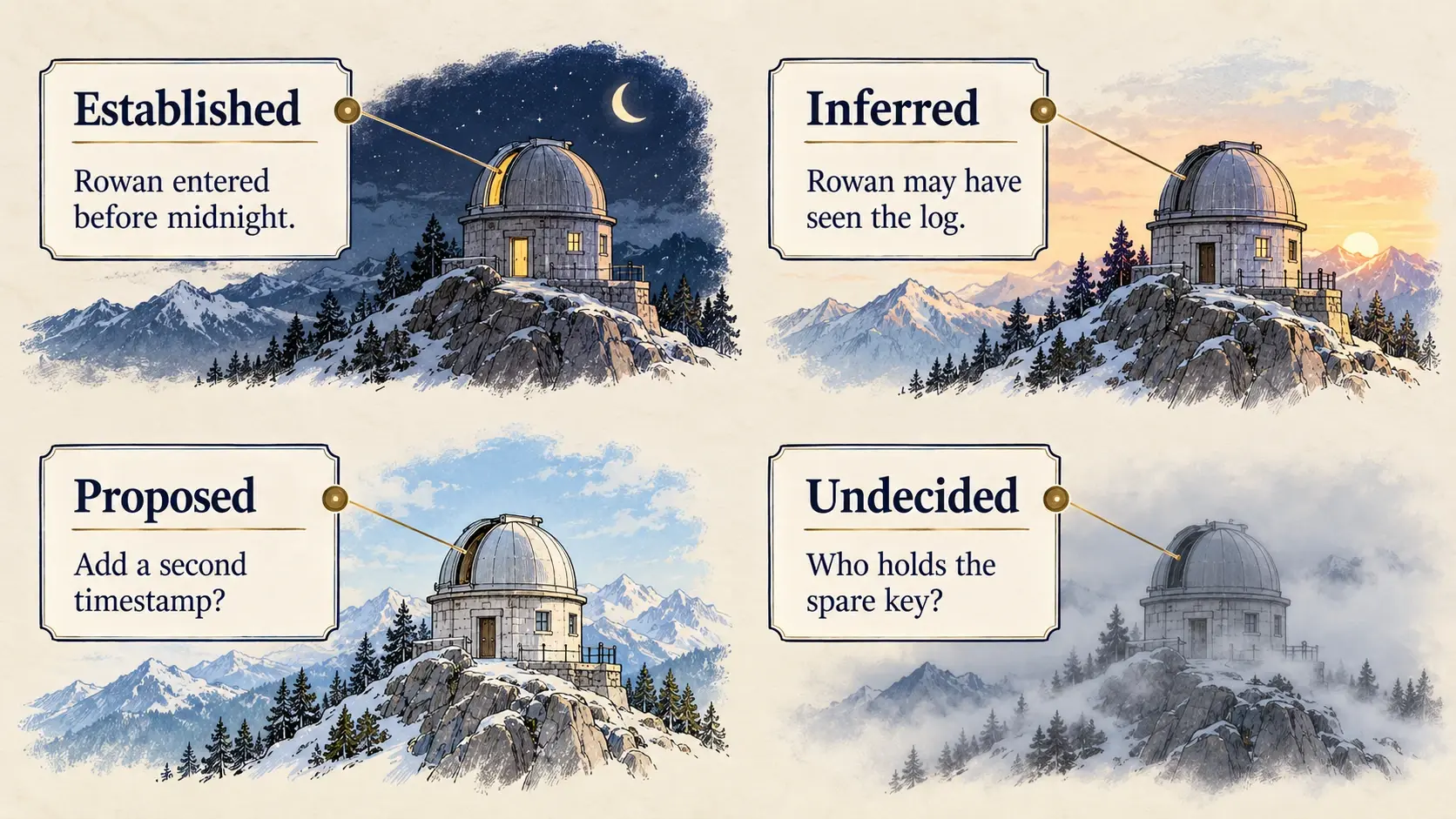
| Label | What belongs there | Example |
|---|---|---|
| Established | A fact stated in the accepted draft | Rowan entered the control room before midnight. |
| Inferred | A plausible interpretation needing review | Rowan may have seen the altered log. |
| Proposed | A new creative option | The log contains a second timestamp. |
| Undecided | A question you have not settled | Who has the spare control-room key? |
These labels support different writing decisions. A proposed timestamp should not become a clue in chapter six until you decide to use it. An inference can remain useful without being treated as something the character definitely knows.
Write Entries That Can Be Checked
Prefer a specific statement and source label to a vague personality summary. “Rowan refuses to give the key to visitors in scene 3” is easier to verify than “Rowan is cautious.” You can still include interpretations, but distinguish them from observed behavior.
Where the draft contains conflicting facts, record both passage labels and the question to resolve. Do not ask the model to choose whichever sounds more likely. The contradiction may reflect an intentional lie, an unreliable narrator, or a revision you have not propagated.
Update After a Rewrite, Not Only After a Chapter
A revised travel time can affect the timeline, an alibi, and the arrival of a message. Ask for affected entries rather than simply replacing the number in one location. Then check whether scenes already written still work.
Keep a short change log: old fact, new fact, affected scenes, and decision. This makes it easier to distinguish a forgotten update from a deliberate contradiction. Do not keep obsolete details in the context packet unless you explicitly need them for comparison.
Common Story Bible Questions
Does a short story need one? Often a small reference is enough. Track the facts that can cause errors, such as names, knowledge, object locations, and a speculative rule. Expand only when the story requires it.
Will an AI remember the complete reference? Do not depend on automatic recall. Supply the relevant entries in new requests and review what the response actually used. Keep your own source of accepted facts.
Can the bible replace an outline? No. An outline plans the event sequence; the bible records the facts that sequence must respect. A sound project can use both without duplicating every paragraph.
Build the Smallest Reference You Will Maintain
Start with the facts your next scene needs, label uncertainty honestly, and update the accepted version when the story changes. A compact reference you keep using will serve the manuscript better than a large document filled with decisions you never made.