You start with a question. Perplexity searches the web, gathers sources and gives you a cited answer. Then the work changes: you need to find an original angle, develop a narrative, rewrite it several times and create visuals that belong to the same idea.
That handoff is the real difference between XPT and Perplexity.
Perplexity is the stronger choice when finding and checking information is the main job. XPT is the better fit when research is only the starting material and you want more freedom to keep creating across text and images.
Perplexity is not limited to search. It can write, analyze files, generate images and videos, and create documents, spreadsheets, presentations and apps on paid plans. The distinction is about where each product feels most natural: Perplexity begins with information; XPT begins with what you want to make.
A Research Brief Reaches a Fork
Imagine this brief:
Research how independent creators are using AI, then turn the findings into a campaign concept, a long-form article and a set of visual directions.
In Perplexity, the natural path is:
- Search the topic and narrow the question.
- Review the cited answer and open the strongest sources.
- Run a deeper Research query for a more complete report.
- Export or reuse the result in a document or another workflow.
In XPT, the natural path starts later:
- Bring in the useful findings or your own notes.
- Challenge the obvious angle and explore several creative directions.
- Develop the strongest direction into a full draft.
- Revise the voice, structure and emotional tone without restarting the project.
- Turn the same concept into image prompts and visual variations.
Neither path makes the other unnecessary. They simply solve different parts of the assignment.
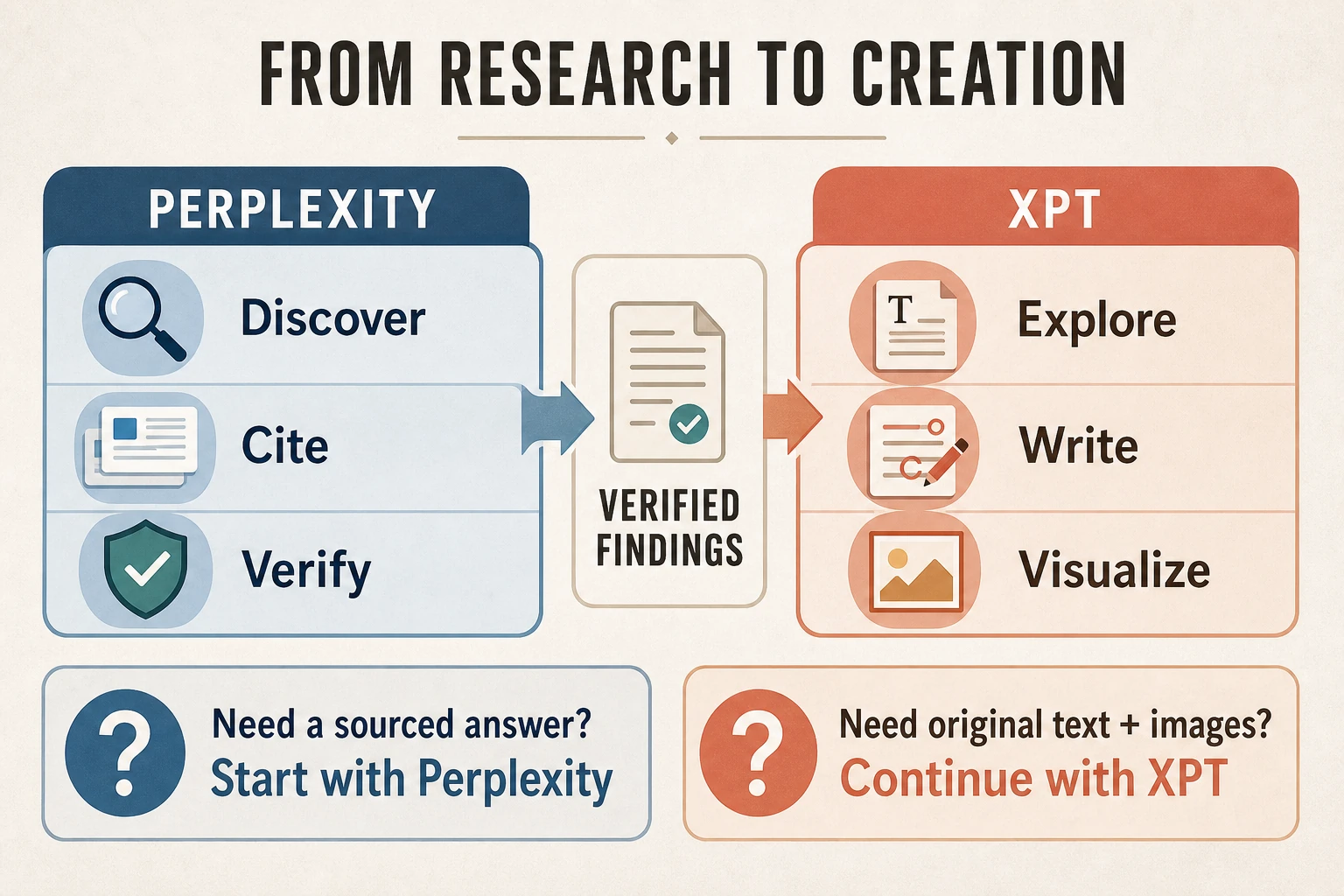
Perplexity is strongest at turning questions into verified findings; XPT carries those findings forward into original text and images.
Perplexity Is Strongest Before the Blank Page
Perplexity works like an answer engine built around live retrieval. Its answers normally include numbered citations, so you can inspect where a claim came from instead of receiving an unsupported summary. That makes it particularly useful for market scans, product comparisons, travel planning, current events and unfamiliar subjects.
Its Research mode goes beyond a single search. Perplexity says the mode performs multiple searches, reads many sources, reasons through the material and produces a report that can be exported as a PDF or document. The model is selected automatically in this mode.
Paid users also receive access to advanced models, additional file analysis, Projects and higher allowances for search and creation features. If your day begins with “What is true, what changed, and which sources should I read?”, Perplexity has a clear advantage.
It still needs human verification. A citation may support only part of a sentence, point to a secondary source or fail to capture an important qualification. The links make checking easier; they do not remove the need to check.
The Handoff from Evidence to Original Work
Research answers are usually compressed toward what can be supported by sources. Creative work often needs the opposite movement: expansion, ambiguity, multiple voices, unusual combinations and several rounds of revision before the direction becomes clear.
This is where XPT becomes more useful. It is designed for sustained, open-ended creation rather than treating every conversation as a search result. You can use the Unfiltered AI Writer to develop a rough premise into different structures, voices and full drafts without turning each revision into a new research task.
The difference becomes more visible when text and images belong to one project. Perplexity now supports image generation and editing, so it would be inaccurate to describe it as a text-only tool. Its own help center presents images as a way to complement a search, with access and quality allowances varying by plan.
XPT keeps visual creation closer to the creative conversation. Once the concept, setting and tone are established, the Uncensored AI Image Generator lets you continue into visual interpretations without rebuilding the idea from scratch in a separate search-led workflow.
One practical detail matters for professional creators: Perplexity states that images generated on its individual Free, Pro and Max plans are for personal, non-commercial use; commercial use is available on Enterprise plans. Check the current terms of any platform before publishing or selling generated work.
Test Both with One Brief
A useful comparison should not ask both tools for a generic 500-word article. Give them a brief that includes research, judgment and creation:
Identify three changes in how people discover independent digital products. Cite reliable evidence, then propose one unexpected campaign angle. Write a concise creative brief, a landing-page opening and four visual concepts. Keep revising the same direction after feedback.
Judge the result at four checkpoints:
Evidence: Are the sources current, relevant and correctly attached to the claims? Perplexity should be easier to audit here.
Originality: Does the idea move beyond a summary of common opinions? XPT should have more room to explore and reframe.
Revision: Can you change the audience, voice or central tension while preserving the useful parts of the project?
Visual continuity: Do the image directions feel connected to the written concept, or do they look like separate prompt exercises?
This test reveals more than a long feature checklist because it follows the work from question to finished creative direction.
Where Perplexity Users Encounter Friction
According to Reddit user discussions, people often praise Perplexity for fast research and visible sources, while raising a few recurring concerns:
- Citations can look convincing before the linked page is checked closely.
- Heavy users may find search and Research allowances difficult to predict.
- Changes in model access or routing can make results feel less consistent.
- The jump from Pro to Max is difficult to justify unless the advanced research and agent features are used frequently.
These are user-reported experiences, not universal outcomes. They point to a sensible buying rule: test the exact research mode, model access and allowance pattern you expect to use instead of subscribing for a feature name alone.
XPT solves a different kind of friction. Its value is not that every answer comes with more sources. It is that a legitimate creative project can keep moving through drafts, alternatives and visual ideas without constantly returning to a search-first format.
Choose One—or Use a Deliberate Handoff
Choose Perplexity if your final deliverable is a sourced answer, research report or evidence-backed summary. It is also the more natural first stop when the subject is unfamiliar or changing quickly.
Choose XPT if you already have the information—or if information gathering is only a small part of the job—and the real challenge is turning it into distinctive writing and images. XPT gives the creative process more room to continue after the first acceptable answer.
Price can still help settle the choice. Perplexity has a free plan, with Pro at $20 per month and Max at $200 per month. XPT starts at $12.90 per month, followed by Max at $29.90 and Ultra at $79.90. These are not matching tiers: pay for Perplexity when cited research replaces substantial manual search, and pay for XPT when writing, revision and visual development are the repeated work.
For some projects, the best setup is sequential rather than exclusive:
Perplexity for discovery and verification → XPT for interpretation, writing, revision and visual development.
If your decision is less about citations and more about real-time social context, XPT vs Grok examines a different kind of search-and-creation workflow.
The Bottom Line
Perplexity is easier to recommend when the question is the product: it finds information quickly, shows its sources and can produce a structured research result.
XPT is easier to recommend when the answer is only the beginning. It gives writers and visual creators a more focused space to keep exploring, revising and turning one idea into multiple forms.
The simplest decision is this: use Perplexity to understand the world; use XPT to decide what you want to create from it.